
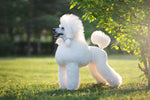
How to Properly Care for a Poodle Coat
, by Georgia Huyton, 6 min reading time
, by Georgia Huyton, 6 min reading time
While we refer to “poodle coats” throughout this article, the same advice applies to most curly and wool-coated breeds including Cockapoos, Cavapoos, Labradoodles, Goldendoodles and many other poodle crossbreeds.

As long-time poodle owners ourselves, we spend a lot of time in poodle groups and communities and one thing we constantly see is people struggling with coat maintenance - especially owners trying to keep their poodles in a longer coat.
Sadly, we also regularly see dogs ending up completely shaved due to severe matting. In many cases, owners genuinely thought they were brushing properly, but poodle coats need a very specific approach. A quick brush over the top simply is not enough.
The good news is that with the right tools, products, and technique, maintaining a healthy poodle coat becomes much easier.
At Shanzi Naturals we have developed a natural grooming range designed to help keep coats clean, manageable, and healthy between professional grooms. From shampoos and conditioning sprays to face washes and daily freshening products, everything is designed to support healthy skin and coat condition without harsh ingredients.
You only really need three core tools:
A grooming spray
A slicker brush
A wide tooth comb
Never brush a dry poodle coat.
A light mist of grooming spray helps:
Reduce static
Prevent coat breakage
Add slip to the coat
Make brushing more comfortable
Help protect curls and texture
The coat should not be soaking wet — just lightly dampened before brushing.
For this, we use our Daily Spritz. It is perfect for lightly misting the coat before brushing to help reduce static and make brushing easier and gentler on the hair.

The slicker brush is your main brushing tool. However, this is where many owners go wrong.
You should not be dragging the slicker through the entire coat repeatedly. This often only brushes the surface while leaving hidden knots underneath, especially close to the skin.
Instead, you need to use the line brushing technique.
Line brushing means working through the coat in small sections, one layer at a time.
You gently part the coat and brush a thin line of hair from root to tip before moving upwards section by section. This ensures you are actually reaching the skin and properly removing tangles before they become mats.
It takes longer than surface brushing, but it is the difference between:
A genuinely maintained coat
A coat that looks brushed but is secretly matting underneath
Areas that commonly matt quickly include:
Behind the ears
Armpits
Collar area
Legs
Tail base
Under harnesses
These areas often need extra attention.
The comb is not just an optional extra — it is your “check” tool.
Once you have brushed a section with the slicker, you should be able to pass the wide tooth comb cleanly through the coat from root to tip.
If the comb catches, there are still tangles there.
A lot of owners stop after brushing because the coat looks fluffy, but the comb tells the truth.

This is one of the biggest mistakes people make.
If your poodle has tangles or small knots before a bath, shampooing the coat can tighten them dramatically and turn them into proper mats.
Water and shampoo cause tangled hair to tighten together.
Before bathing:
Thoroughly line brush the entire coat
Comb check every section
Make sure the coat is fully tangle free
Only then should you bathe your dog.
Using a quality shampoo and conditioner also makes a huge difference. Harsh shampoos can dry the coat and make tangling worse, especially in curly breeds like poodles.
Our Natural Dog Shampoo is designed to gently cleanse the coat without stripping natural oils, helping leave the coat soft, manageable and easier to maintain.
For extra softness and manageability, our Natural Conditioner helps soften the coat and improve brushing, especially useful for longer-coated poodles prone to tangling.
Many owners focus entirely on the haircut, but coat condition plays a huge role in how easy a poodle is to maintain. A healthy, conditioned coat is often far less prone to matting than a dry or brittle one.

Some owners prefer the big fluffy “blown out” straight coat look after grooming, while others prefer to keep the natural curls.
If you prefer a curlier finish:
Finish your brushing first
Lightly dampen the coat again afterwards
Go through with the comb
Allow the coat to air dry naturally
This helps the curls reform instead of drying fluffy and straight.
Poodle coats are beautiful, but they are high maintenance. There is no way around it.
Even dogs that are professionally groomed every 6–8 weeks still need proper home maintenance between appointments — especially if kept in longer trims.
A few minutes of proper brushing several times a week is far kinder than a full shave down caused by painful matting.
Once mats become tight against the skin, shaving is often the only humane option.

If you are keeping your poodle in a longer coat, we would recommend:
A quality slicker brush
A wide tooth comb
Combined with proper line brushing, these simple tools can make a massive difference in keeping your poodle comfortable and mat free.
You can browse our full range of natural shampoos, conditioners, sprays and grooming products here:
Shanzi Naturals Grooming Collection
Most matting is not caused by neglect. It is usually caused by owners simply not being shown the correct technique.
Poodle coats need:
The right tools
The right method
Consistency
Once you learn how to properly line brush and comb check the coat, maintenance becomes much more manageable and your dog stays far more comfortable too.


